Yaesu FTM-400
Lightning Strike Damage Analysis: Yaesu FTM-400 Destroyed via Diamond X700 Antenna Feedline
AYBERK BLOG
Yaesu ftm 400
Outdoor antennas provide significant performance advantages in amateur radio installations by improving coverage, signal quality, and overall operating efficiency. However, they also expose radio equipment to one of the most destructive natural phenomena: lightning. Without proper grounding and surge protection, a lightning strike does not need to hit the antenna directly to cause catastrophic damage. In many cases, a nearby strike is sufficient to induce extremely high voltages into the antenna system through electromagnetic coupling.
This article documents a real-world incident in which a Diamond X700 VHF/UHF base antenna conducted lightning energy through its coaxial feedline, resulting in severe and irreversible damage to a Yaesu FTM-400 mobile transceiver. The event ultimately destroyed the radio’s main printed circuit board along with multiple critical internal subsystems.
About the Yaesu FTM-400
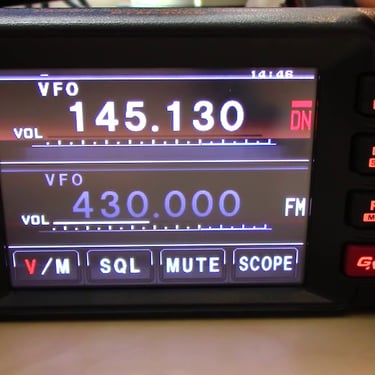
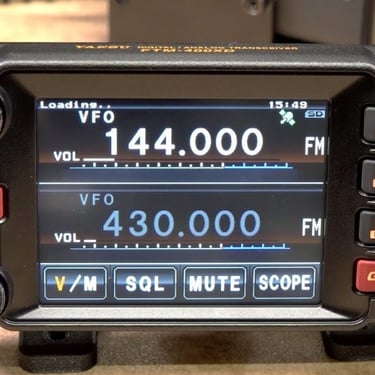
The Yaesu FTM-400 is a dual-band VHF/UHF mobile transceiver designed for advanced amateur radio operation. It supports both analog FM and Yaesu’s C4FM System Fusion digital mode, and it is widely regarded for its feature set and receiver performance. Internally, the radio uses a superheterodyne receiver architecture with discrete RF filtering, low-noise amplifier stages, intermediate frequency processing, and DSP-based baseband decoding. Integrated GPS, APRS functionality, a touchscreen interface, and advanced MCU control make it a complex and capable transceiver.
While the FTM-400 is robust under normal RF operating conditions, it is not designed to withstand kilovolt-level transient energy entering through the antenna connector. Like most amateur transceivers, its RF front-end protection is intended for static discharge and minor surges, not lightning-induced currents.
Incident Overview
In this incident, a Diamond X700 high-gain outdoor VHF/UHF antenna was connected directly to a Yaesu FTM-400 via a coaxial feedline. The installation lacked a gas-discharge lightning arrestor, and grounding was either insufficient or ineffective. During a thunderstorm, lightning struck either the antenna itself or a nearby structure. The resulting electromagnetic pulse and surge current were coupled into the antenna system and propagated along the coaxial cable directly into the radio.
Electrical Nature of Lightning Damage
Lightning involves extreme electrical conditions, with voltages ranging from tens of kilovolts to megavolts, currents reaching tens of kiloamperes, and rise times measured in microseconds or less. Under these conditions, the coaxial cable effectively behaves as a transmission line, delivering a high-energy transient directly into the radio’s RF input circuitry. Conventional fuses and power-line protection mechanisms are completely ineffective in this scenario, as the destructive energy does not enter through the DC power input.
The lightning-induced current bypasses the power supply entirely and enters the radio through the RF signal path, overwhelming the protection devices almost instantaneously.
Damage Progression Inside the Yaesu FTM-400
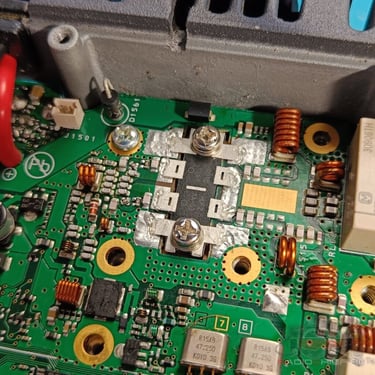
The first components to fail were the RF input protection devices, including ESD diodes and transient suppression elements. These components are designed to handle electrostatic discharge and small RF transients, but they are incapable of dissipating lightning-level energy. Once these protective components failed, the surge propagated deeper into the radio’s internal circuitry.
The low-noise amplifier in the receiver chain suffered semiconductor junction breakdown due to excessive voltage. Internal bias lines shorted, rendering the receiver completely inoperative and reducing receive sensitivity to zero. From this point onward, normal receiver operation was impossible.
The damage then extended into the frequency generation circuitry. The PLL and VCO sections exhibited visible damage, including burned traces and failed control lines. Without a functional PLL lock, the radio could no longer generate stable operating frequencies, which disabled both receive and transmit functions.
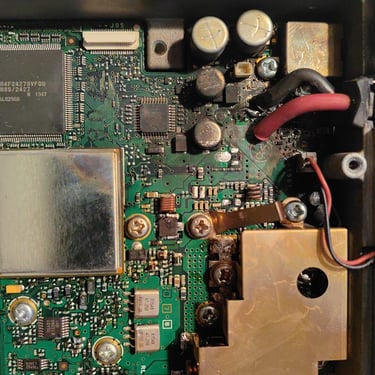
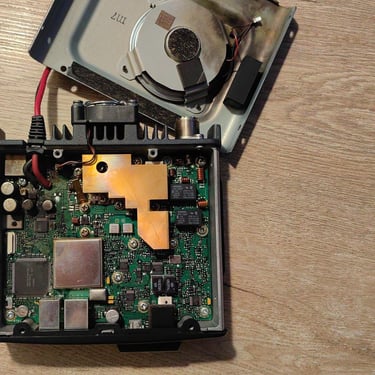
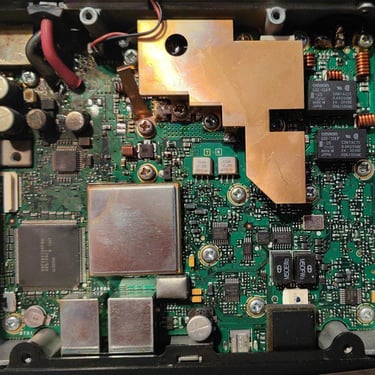
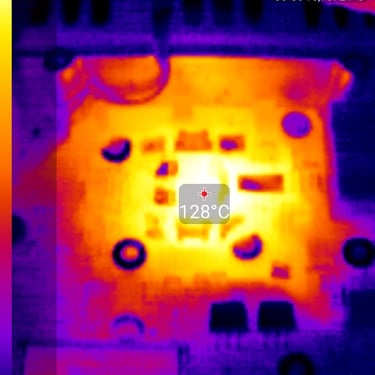
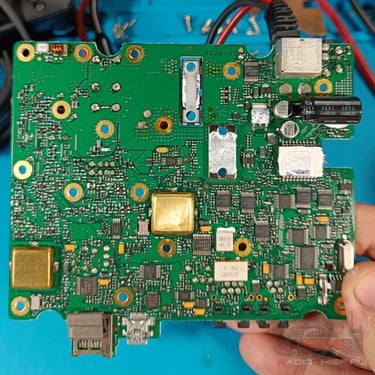
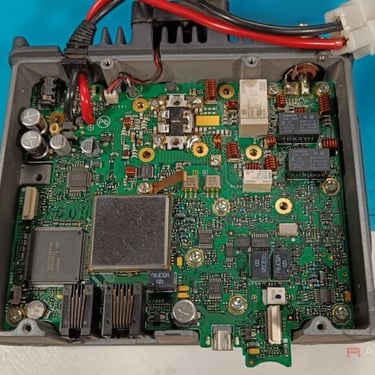
The most severe damage occurred on the main PCB itself. Multiple layers of the board showed signs of carbonization, power and signal traces were burned open or shorted together, voltage regulators failed catastrophically, and MCU-related power rails were compromised. Once a multilayer PCB becomes carbonized, it effectively turns into a conductive path, making reliable repair both technically impractical and economically unjustifiable. In this case, the radio was deemed beyond repair.
Why Power-Line Fuses Do Not Protect Against Lightning
A common misconception among radio operators is that power-line fuses can protect equipment from lightning damage. In reality, lightning-induced damage almost always enters through the antenna system rather than the DC power input. Fuse response times are far too slow to react to microsecond-scale transients, and the energy bypasses the power supply circuitry entirely. Effective lightning protection must therefore be implemented at the antenna and feedline level, not solely at the power input.
Preventive Measures and Best Practices
This incident highlights several critical preventive measures that should be considered mandatory for any outdoor antenna installation. A gas-discharge lightning arrestor should be installed in the antenna feedline, preferably near the antenna base or at the building entry point. Proper grounding is essential; the antenna mast, lightning arrestor, and station ground must all be bonded to a single low-impedance grounding system. During thunderstorms, physically disconnecting the coaxial cable from the radio remains the safest and most reliable protection method. Additionally, grounding the coaxial cable shield at appropriate points helps reduce induced currents and improves overall system safety.
Conclusion
The Diamond X700 antenna delivered excellent RF performance, but without proper lightning protection it became a direct conduit for destructive energy. In this incident, lightning-induced current traveled through the coaxial cable and completely destroyed the Yaesu FTM-400, including its RF front-end, frequency synthesis circuitry, and main PCB.
This case serves as a clear technical lesson for amateur radio operators: high-performance antenna systems must always be paired with proper grounding and lightning protection. The cost and effort required to implement these precautions are minimal compared to the loss of a high-end transceiver and the potential safety risks involved.